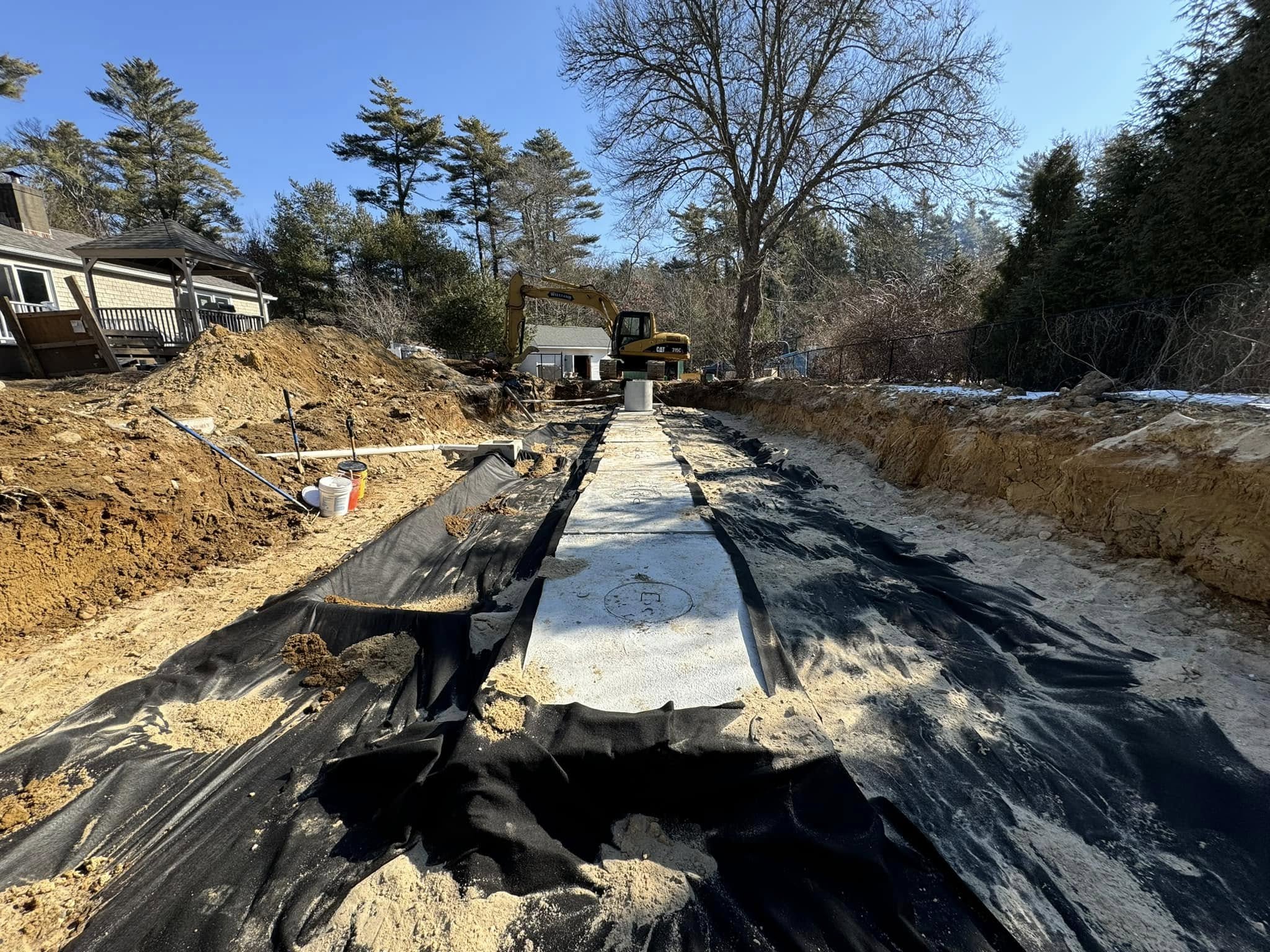
Quick answer: If your Title 5 septic inspection fails, Massachusetts law requires you to repair or replace your septic system, which almost always means a new septic installation and excavation. Across Plymouth County towns like Plymouth, Kingston, Duxbury, and Carver, and down onto Cape Cod (Barnstable County) in Barnstable, Falmouth, Yarmouth, and beyond, that process involves a local Board of Health permit, a design from a licensed engineer, and — because of high water tables, nitrogen-sensitive watersheds, and conservation commission oversight near wetlands and coastal areas — often additional environmental review. Typical septic installation and excavation costs in the region run $15,000–$40,000+, and the work usually takes 1 to 3 weeks from permit approval to backfill.
Below, we break down exactly what's involved, why Plymouth County and Cape Cod (Barnstable County) properties come with unique challenges, and how to avoid the delays that trip up most homeowners.
What Is Title 5, and Why Does It Trigger Excavation?
Title 5 is the Massachusetts state sanitary code (310 CMR 15.000) that governs septic system design, construction, and inspection. Every property with a septic system must pass a Title 5 inspection when the property is sold, when the system is expanded, or periodically as required by local Boards of Health.
If an inspector finds your system is a "significant threat to public health or the environment" — common findings include a failed leach field, a cracked tank, or a system too close to a well or wetland — the state requires you to upgrade or replace it, typically within two years (or immediately if it's an imminent health hazard). That upgrade requires a new septic installation: digging up and replacing part or all of the system, which is where excavation comes in.
Why Plymouth County & Cape Cod Properties Require Specialized Septic Installation
A septic installation or excavation contractor working near Boston faces different conditions than one working from Plymouth down to the Cape (Barnstable County). Here's what makes this region distinct:
Nitrogen-Sensitive Watersheds on Cape Cod
This is the single biggest factor shaping septic installation work on the Cape (Barnstable County). Decades of conventional septic systems have driven excess nitrogen into coastal embayments, harming eelgrass and shellfish habitat. Under the Cape Cod Area Wide Water Quality Management Plan (the "208 Plan"), many towns — including Falmouth, Barnstable, Mashpee, and Orleans — now require or incentivize Innovative/Alternative (I/A) septic systems that actively reduce nitrogen output. These systems have a larger footprint, additional electrical and monitoring components, and a meaningfully different excavation scope than a standard system.
Sandy Soil and High Water Tables on the Cape
Cape Cod (Barnstable County) sits on a glacial outwash plain, so soil is largely sand and gravel — excellent for drainage but combined with a narrow peninsula and shallow groundwater, it often limits how deep a conventional system can be buried. Title 5 requires a minimum separation between the leach field and the seasonal high water table; when the sandy soil doesn't allow it, a raised or mounded design is required, which changes fill needs and grading for the septic installation.
Percolation Tests and Unsuitable Soil Strip-Outs
Before any Title 5 system can be designed, state regulations require a deep observation hole and percolation ("perc") test under 310 CMR 15.104 and 15.240. A certified soil evaluator digs a test hole to examine soil layering and groundwater depth, then measures how quickly water drains from a saturated hole, recorded in minutes per inch. This percolation rate, along with the soil texture observed in the test pit, determines how the leach field must be designed and sized.
If the native soil percolates too slowly, or the soil evaluator finds unsuitable material — fine sand, silt, or clay layers that don't meet the particle-size and permeability standards in 310 CMR 15.255 — Title 5 requires a soil replacement, commonly called a "strip-out." This means excavating the unsuitable native soil beneath and around the proposed leach field to the depth specified by the design engineer, then replacing it with system sand that meets Title 5's required gradation. Strip-outs are common across Plymouth County and Cape Cod, where soil layers can vary significantly within a single lot, and they add excavation depth, material cost, and time beyond a standard installation.
Conservation Commission Review Near Wetlands and Coastal Areas
Much of Plymouth County and virtually all of Cape Cod sits near wetlands, marshes, kettle ponds, or coastal resource areas regulated under the Massachusetts Wetlands Protection Act. A septic project within a Conservation Commission's jurisdiction needs their sign-off in addition to the Board of Health permit — a review cycle that can add several weeks, so it pays to start early.
Ledge and Glacial Till Inland in Plymouth County
Move inland to towns like Plymouth, Carver, and Kingston, and the terrain shifts to glacial till with buried boulders and occasional ledge outcrops — a legacy of the same glacier that left Cape Cod's sandy soil behind. Hitting ledge mid-excavation can require hydraulic hammering, adding cost and time a standard quote won't always anticipate.
Small, Older Lots — Especially in Cape Cod's Village Centers
Many neighborhoods in Cape Cod villages and older Plymouth County subdivisions predate modern lot-size and setback requirements. Fitting a code-compliant leach field — particularly a nitrogen-reducing I/A system with its larger footprint — on a small, older lot often requires creative engineering and a more involved excavation plan.
What the Excavation Process Actually Looks Like
- Title 5 inspection and failure report. Your inspector files the report with the local Board of Health.
- Design by a licensed engineer. A civil or sanitary engineer designs the replacement system based on soil testing (a "perc test") and site conditions.
- Permitting. The design goes to the Board of Health, and — if applicable — the Conservation Commission.
- Excavation and installation. The contractor excavates the old tank and leach field, installs the new system, and backfills.
- Final inspection and as-built certification. The Board of Health signs off, and the engineer files an as-built plan with the town.
Total timeline from failed inspection to completed system is typically 6–12 weeks, with permitting often taking longer than the physical excavation itself.
What Does Septic Installation & Excavation Cost in Plymouth County & Cape Cod (Barnstable County)?
| System Type | Typical Cost Range |
|---|---|
| Conventional gravity system | $15,000 – $25,000 |
| Pressure-dosed system | $20,000 – $30,000 |
| Alternative (I/A) system, mound, or raised bed | $30,000 – $45,000+ |
| Additional cost if ledge or unsuitable is encountered | +$3,000 – $10,000 |
Costs vary based on soil conditions, system type, permitting complexity, and access to the site. On Cape Cod, projects in a nitrogen-sensitive watershed will typically land at the higher end of the range (or above it) because I/A systems cost more to install and maintain than conventional ones. Get a fixed-scope quote in writing that specifies what happens if ledge or unexpected groundwater is found; this is the single biggest source of cost overruns.
Frequently Asked Questions
Do I need a permit for septic installation or excavation in Massachusetts?
Yes. Any septic installation, repair, or replacement requires a permit from your local Board of Health, based on a design filed by a licensed engineer. Properties near wetlands may also need Conservation Commission approval.
How long does a Title 5 septic replacement take in Plymouth County or Cape Cod?
Most projects take 6 to 12 weeks from the failed inspection to final sign-off, with permitting typically the longest phase. The physical excavation and installation itself usually takes 1 to 3 weeks.
Can I sell my house if my septic system fails Title 5?
Yes, but Massachusetts requires either the repair to be completed before closing, or an escrow agreement where the buyer or seller sets aside funds to complete the repair within two years of the sale.
What happens if the excavation crew hits ledge rock?
The crew will typically need hydraulic breaking equipment to remove it, which adds time and cost. A good contractor will inspect soil test data before quoting and flag ledge risk upfront, though it can't always be predicted with certainty until digging begins.
Is a raised or mounded septic system more expensive to excavate?
Yes. Mounded systems require significant imported fill material and more careful grading, which increases both material and labor costs compared to a standard in-ground system.
Why do I need a nitrogen-reducing (I/A) septic system on Cape Cod?
Many Cape Cod towns require or strongly encourage I/A systems under the Cape Cod Area Wide Water Quality Management Plan, which aims to reduce nitrogen pollution damaging local ponds, bays, and estuaries. Whether it's required for your property depends on its location relative to mapped nitrogen-sensitive watersheds, your local Board of Health or a septic system designer can confirm this for your address.
What is a percolation test, and why might it mean I need a soil strip-out?
A percolation test measures how quickly water drains through your soil, a requirement under 310 CMR 15.240 that determines how your leach field must be sized and designed. If the test shows soil that drains too slowly, or the soil evaluator finds unsuitable material that doesn't meet the standards in 310 CMR 15.255, Title 5 requires a soil replacement, or "strip-out": excavating the unsuitable native soil and replacing it with approved system sand. This adds excavation depth, material cost, and time to the project.
Septic Installation & Excavation Service Areas
Williams Co. Excavation provides Title 5 septic installation and excavation services throughout Plymouth County and Cape Cod (Barnstable County), including:
- Plymouth, MA
- Kingston, MA
- Duxbury, MA
- Carver, MA
- Barnstable, MA
- Falmouth, MA
- Yarmouth, MA
- Mashpee, MA
- Sandwich, MA
- Bourne, MA
Don't see your town listed? View our full service area or contact us to confirm coverage.
Williams Co. Excavation has completed Title 5 septic excavations throughout Plymouth County and Cape Cod, including Sandwich, Falmouth, and Bourne. If your system failed inspection, contact us for a site evaluation and fixed-scope quote.